
I’m a global change ecologist at the California Academy of Sciences. My research focuses on anthropogenic vegetation transitions in western North America, spanning both montane forests and urban systems. I draw on natural history, large-scale geospatial modeling, community science, and environmental ethics, and I work to make ecological science legible to the communities who affect and are affected by changing ecosystems.

Research Overview

Where and how are vegetation-type transitions occurring? (Fig. 1 Understanding)
I use historical vegetation data, modern forest inventories, and environmental data to characterize climate-induced range shifts. I primarily study vegetation-climate mismatch in the Sierra Nevada (i.e. “zombie forests”), with parallel work on urban refugia and the conservation value of urban biodiversity.
What are the impacts of these transitions? (Fig. 1 Ecosystem services & Management)
I investigate the consequences for fire regimes, carbon storage, biodiversity, and the human communities embedded in these landscapes. Recent work includes wildfire behavior in zombie forests and co-authorship of the Nature and Climate Change chapter of The Nature Record.
How to manage these transitions ethically and effectively? (Fig. 1 Relations via community science)
I develop ethical frameworks, community science platforms, and co-created management strategies that strengthen the reciprocal relationships between scientists, decision-makers, and local communities. This includes work to reframe nativeness as a gradient to better manage ecosystems in transition, a suite of tools to make biodiversity data more legible to the community scientists who collect it and the decision-makers who act on it, and community science campaigns that ground this work in local communities.
Select Publications
Projects


Experience


Select Media


Web Applications
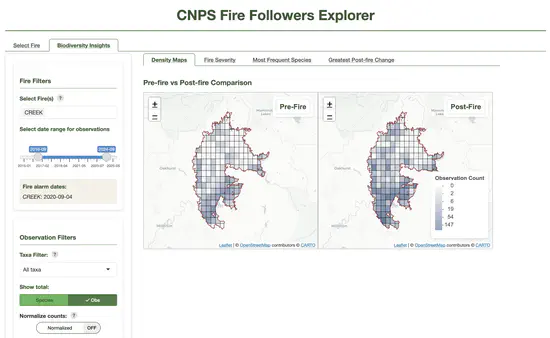
CNPS Fire Followers Explorer
Interactive application to explore plant biodiversity patterns before and after wildfire events in California using data from the California Native Plant Society “Fire Followers” iNat project.
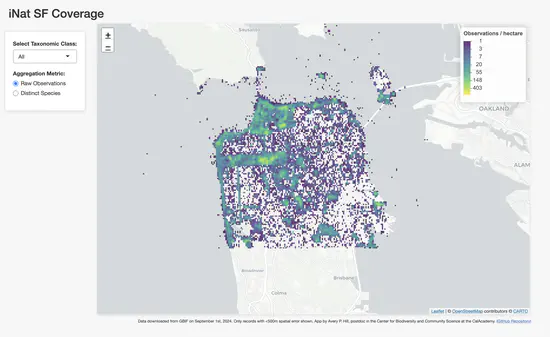
San Francisco iNaturalist Coverage Explorer
Interactive map exploring biodiversity observations and spatial coverage patterns across San Francisco using iNaturalist data.
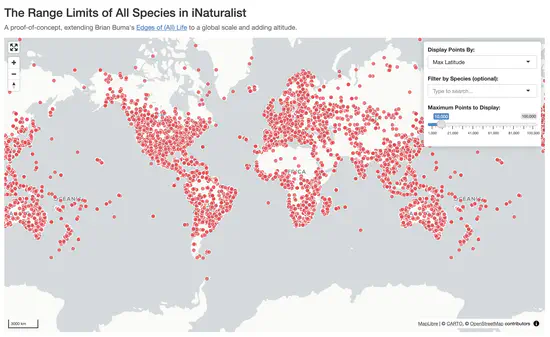
Range Limits of Every Species in iNaturalist
A proof-of-concept, extending Brian Buma’s “Edges of (All) Life” to a global scale and adding altitude.
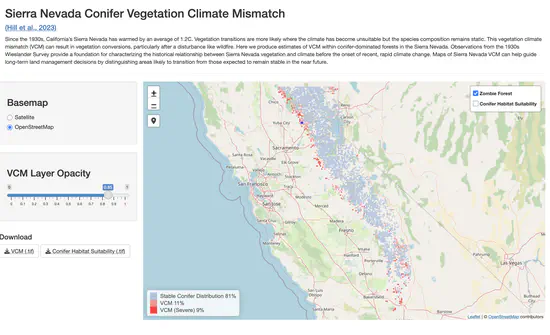
Zombie Forests Explorer
Interactive tool for exploring vegetation-climate mismatch in Sierra Nevada conifer forests.
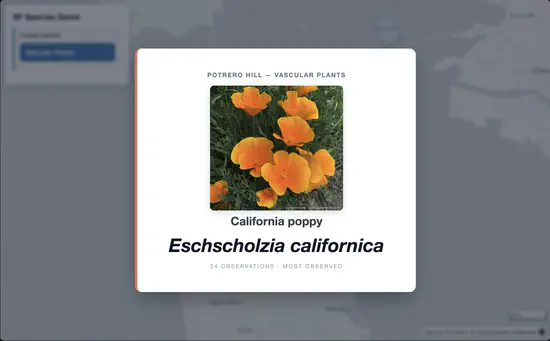
SF Biodiversity Game
A quick game to guess which is the most observed taxon in your San Francisco neighborhood. We use this at public events.